Wear the Green Future

Focus Areas

Toolkit Development for Advancing Circularity in the Textile & Fashion Sector in Kenya

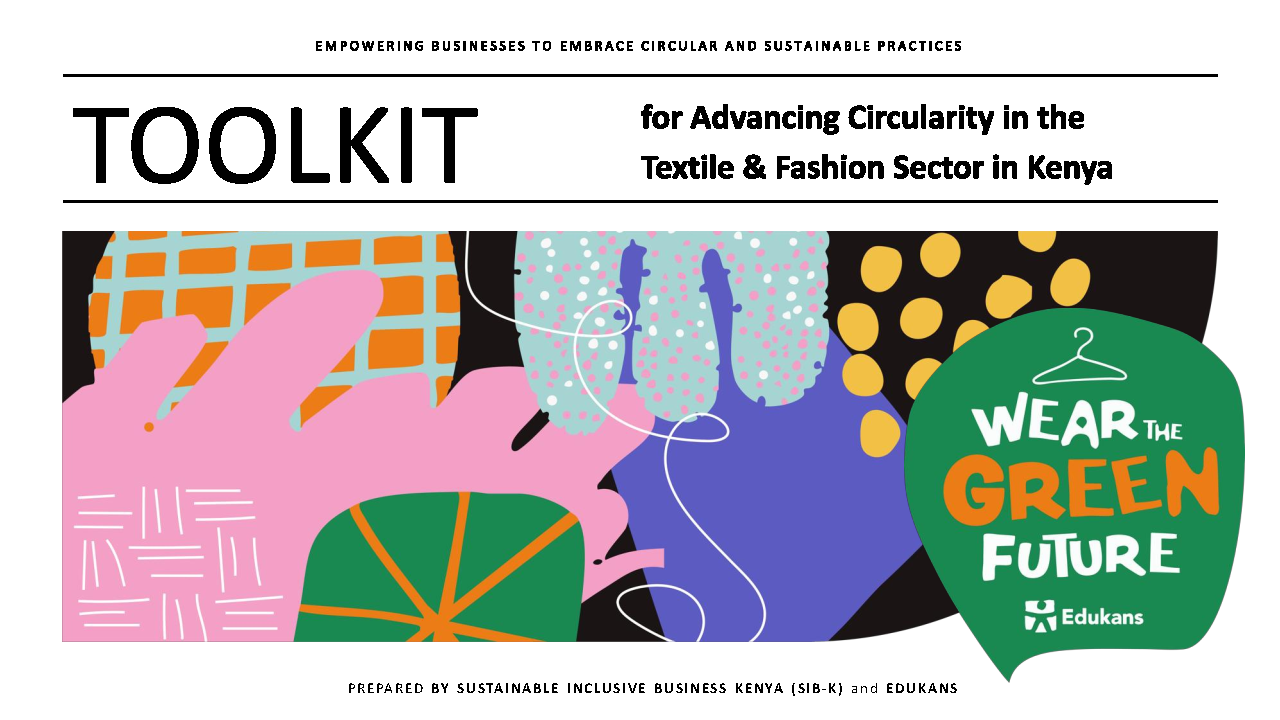
During the 10th Annual Circular Economy Conference, we officially launched the Toolkit for Advancing Circularity in Kenya’s Textile & Fashion Sector.

Developed to address urgent industry challenges, from growing waste and pollution to fast fashion and limited local value-chain integration, the Toolkit equips businesses and stakeholders with practical guidance for building a more sustainable, resilient, and competitive textile ecosystem.

The developed document is a comprehensive Toolkit for Advancing Circularity in the Textile & Fashion Sector in Kenya, designed as a practical guide to help local businesses transition to sustainable, innovative, and resilient circular models. This initiative, part of the “Wear the Green Future” program by Edukans, specifically targets SMEs, fashion designers, manufacturers, and policymakers to address industry challenges like excessive waste, pollution, and a high reliance on imported synthetic fibers.
The toolkit is organized into seven core sections:
  • Section 1: Introduction: Establishes the necessity for circularity in Kenya to counter the rise of fast fashion and the lack of vertical integration in local value chains.
  • Section 2: Understanding Circular Economy (CE): Defines the “7R” principles—rethink, reduce, reuse, repair, remake, and recycle. It provides a historical overview of Kenya’s shift from a cotton-based industry to one dominated by secondhand clothing (mitumba) and examines the high environmental costs of energy and water use in current production.
  • Section 3: Key Circular Strategies: Introduces the Circular Economy Inclusive Loop Framework, which includes narrow (reducing consumption), slow (extending product life), close (reusing materials), and regenerate (restoring ecosystems) loops. It also details sustainable design methods like zero-waste fashion and modular design.
  • Section 4: Tools & Methodologies: Offers technical guides for Material Flow Mapping (MFM) to track resource movement and Lifecycle Analysis (LCA) to measure total environmental impact. It highlights the role of technology, such as 3D design to reduce sampling waste and QR codes for product traceability.
  • Section 5: Policy & Ethics: Explains Extended Producer Responsibility (EPR), which makes businesses legally accountable for their product’s end-of-life waste. It also provides a framework for Gender Equality and Social Inclusion (GESI) to ensure fair opportunities and safe working conditions.
  • Section 6: Awareness & Communication: Focuses on sustainability storytelling, teaching businesses how to use data, social media, and creative partnerships to build consumer trust and market differentiation.
  • Section 7: Financing & Investment: Identifies funding avenues in Kenya, including commercial banks, SACCOs, and government funds like the Youth Enterprise Development Fund.

Download The Toolkit

This toolkit serves as a comprehensive guide for Kenyan textile and fashion businesses to transition toward a circular economy. Created in collaboration with Edukans, the initiative focuses on empowering youth through education in sustainable design, garment repair, and eco-friendly production techniques. The material identifies critical industry challenges, such as the environmental impact of secondhand clothing and the high consumption of water and energy.

External Links of interest

Advancing Circularity: Kenyan Textile, Apparel & Fashion Sector Concludes Milestone Sustainability Workshop

NAIROBI, KENYA – 22nd April,  2026: The transition toward a circular economy in Kenya’s textile and apparel sector took a significant step forward following the successful conclusion of the “Advancing Circularity” workshop at the Kingfisher Nest Hotel in Westlands.

Hosted by Sustainable Inclusive Business (SIB-Kenya) under the Kenya Private Sector Alliance (KEPSA), in partnership with Edukans Kenya and Sprout Africa, the workshop brought together key actors from across the textile, apparel and fashion industry as part of the #WearTheGreenFuture (WTGF) project.

About The Wear The Green Future

The “Wear the Green Future” project is a flagship initiative funded by Nationale Postcode Loterij (NPL) led by Edukans Kenya, and co-implemented by Sprout Africa, and SIB-Kenya. The project is dedicated to equipping young people with the essential skills for sustainable and circular practices within the textile, apparel and fashion industry.
Through training, mentoring, and the establishment of robust networks for small and medium-sized enterprises (SMEs), the program ensures that sustainability becomes a practical approach embedded in everyday production. This includes educating artisans on transforming offcuts and waste materials into high-value products.